Reflection after experience, not suggestion before it.
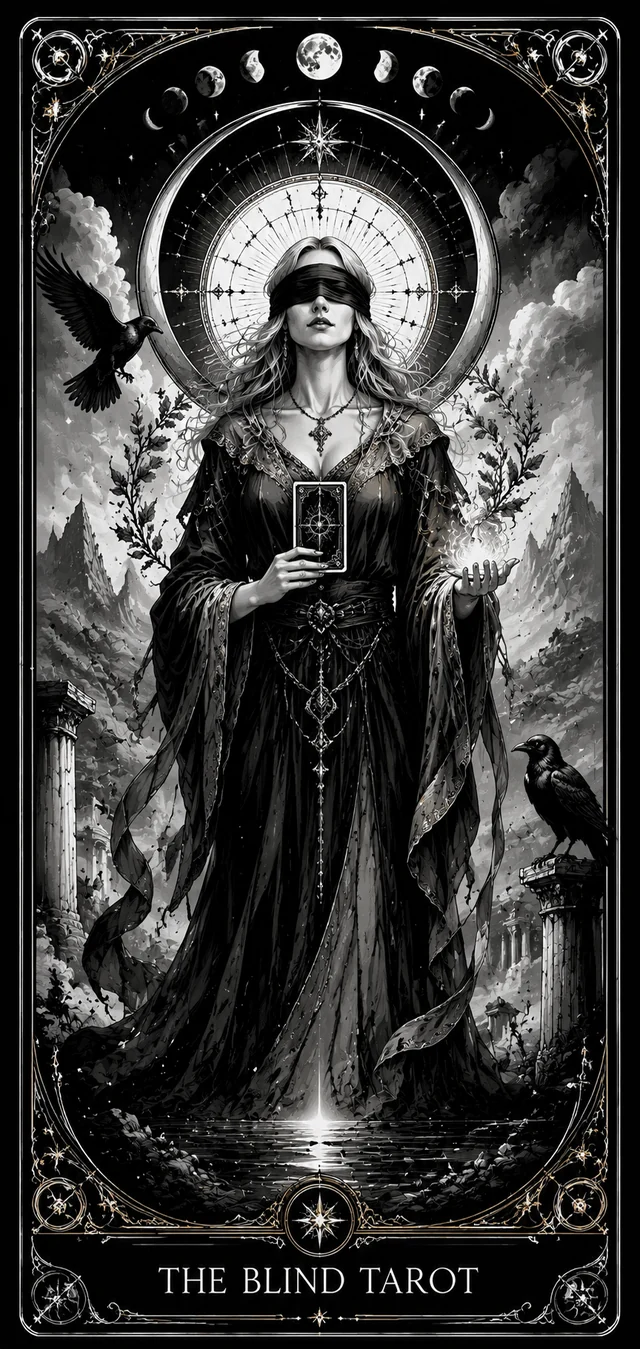
The Blind Tarot began as a simple website and physical card system: one four-character code per card, one direct route per code, and a deliberate delay between drawing and knowing.
The project’s defining concern is temporal. Seeing a symbol before an experience may shape attention, expectation, memory, or interpretation. The Blind Tarot instead asks the reader to live and make a pre-reveal record first, then use tarot as a later symbolic comparison.
The system welcomes spiritual, psychological, aesthetic, skeptical, and uncertain understandings. It does not require the website to make supernatural or scientific claims. A meaningful correspondence may remain meaningful without becoming proof of prediction or causation.
The action–reflection cycle
Life contains action, risk, work, conflict, relationship, negotiation, rest, and uncertainty. These cannot always be performed while analyzing every movement. Reflection becomes valuable when one returns, pauses, examines, learns, and then goes back out into life.
The complete cycle is neither endless action nor endless contemplation, but movement between them.
From stark prototype to field station
The first public site was intentionally minimal and black-and-white. This rebuild preserves its public card routes and four-character map while introducing the emerging Data Pioneer visual language: mountain routes, field instruments, paper records, brass markers, statistical contours, and an explorer who returns with evidence.
The Blind Tarot is created by Joshua Psyche Burnard. The website is one optional tool within a larger physical-first method, book, tracker, card, and research-development project.