
Two QR pathways, one preserved card map.
The original public system used one four-character code per card and a QR payload that opened the card’s direct reveal page. Those routes remain intact. The new prototype introduces a record-first payload that carries the same code into a page that does not reveal it.
Existing printed cards
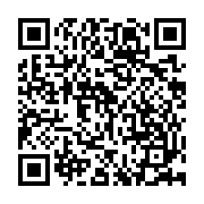
https://theblindtarot.com/cards/zg92.htmlPreserved for backward compatibility. Scanning opens the named card immediately.
Emerging card prototype
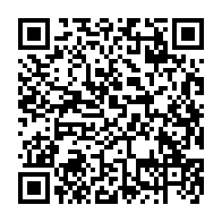
https://theblindtarot.com/record.html?code=zg92Prefills the code but does not load the card map or reveal the identity.
Code convention
| Printed code | Uppercase for legibility, such as ZG92. |
| Stored and URL code | Lowercase, such as zg92. |
| Length | Exactly four alphanumeric characters in the preserved 78-card map. |
| Error correction | Level H in the generated release assets. |
| Quiet zone | Four modules minimum, unobstructed. |
| Color | Near-black ink on paper white; adequate contrast is preserved. |
| Decoration | Frames stay outside the QR and its quiet zone. No logo is placed over modules. |
Package contents
The source release includes SVG and PNG output for all 78 codes in both modes, a generic record-entry QR, a generic reveal-entry QR, the source mapping in JSON and CSV, and a quiet-zone-safe decorative frame overlay. The build and validation scripts can regenerate every asset deterministically.
Static-site concealment is behavioral, not cryptographic.The public card map must exist for direct reveal and compatibility. The record-first page avoids loading that map, but a determined user can still inspect public files. The practice depends on choosing not to reveal early.